
Emergency Shower Compliance according to EN 15154 and ANSI/ISEA Z358.1
In this section we have created an overview of the compliance requirements for emergency showers in laboratories and industrial sites.
What standards apply?
What does my emergency shower need to comply with?
How do I select the correct shower?
How do I remain compliant?
Is my current installation compliant?

What standards apply?
The EN 15154 series provides requirements for emergency safety showers and eyewash equipment used in laboratories and industrial environments, while ANSI/ISEA Z358.1 is widely used as a reference for emergency eyewash and shower equipment in the United States and internationally.
Relevant standards may include:
EN 15154-1 – Plumbed-in body showers for laboratories
EN 15154-2 – Plumbed-in eyewash units
EN 15154-5 – Body showers for industrial and logistics sites
ANSI/ISEA Z358.1 – Emergency eyewash and shower equipment
Understanding which requirements apply to your workplace is the first step towards selecting the right emergency shower solution.
What does my emergency shower need to comply with?
Compliance is about more than installing an emergency shower.
The complete installation must be designed so that it can provide effective first aid immediately after accidental exposure to hazardous substances.
Depending on the applicable standard and risk assessment, important factors include:
Flow
An emergency shower must provide sufficient water to effectively flush hazardous substances from the affected area. The units must deliver water for at least 15 minutes.
For laboratory body showers, EN 15154-1 is the relevant European standard. Where national or local requirements do not specify otherwise, 60 L/min is the general European reference.
But national requirements can differ. Germany can permit 30 L/min for laboratory body showers, while Dutch requirements also define a 30 L/min body shower for specified applications like large kitchens, schools and small laboratories.
Outside laboratories, EN 15154-5 takes a different approach, defining three performance classes, based on the risk assessment:
Class Volume flow rate L/min:
I 30 to 60
II >60 to 100
III >100
According to the ANSI/ISEA Z358.1 standard, the flow rate must be at least 20 GPM (76 L/min).
Water temperature
Water temperature is critical when emergency flushing may need to continue for an extended period. Water that is too cold can make it difficult for an injured person to complete the necessary flushing, while excessively warm water may create additional risks.
EN 15154 specifies a water temperature range of 15–37°C, with 20–25°C generally considered ideal. The emergency shower system should be designed to provide a suitable and stable water temperature throughout the required flushing period.
Spray pattern
An emergency shower does not only need sufficient water – the water must also reach the right area.
The spray pattern should provide effective and consistent coverage of the body or, for eyewash and eye/face wash equipment, the required eye and facial area. Correct installation, water pressure and flow are all important factors in achieving the intended spray pattern.
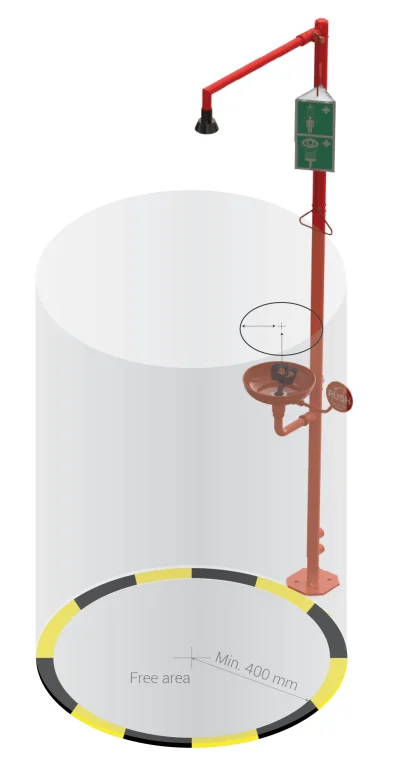
The emergency shower must distribute water effectively over the user’s body. At 700 mm below the shower head, 50% ± 10% of the water must fall within a Ø400 mm central area, while at least 95% must remain within an Ø800 mm area. The water within the central area must be distributed evenly, and the spray velocity must be low enough not to cause injury.
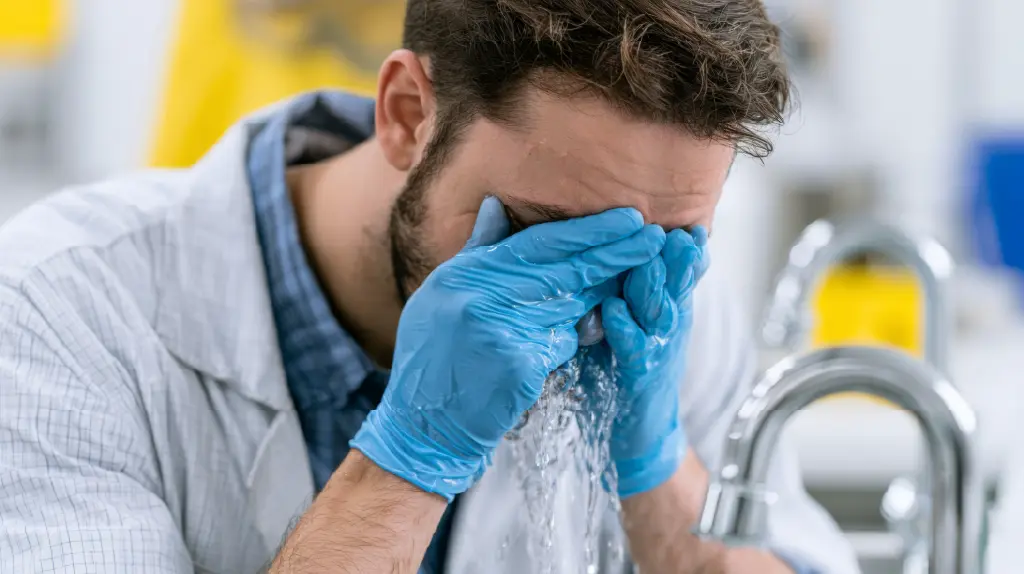
The eyewash must deliver a controlled flow of water, 6 L/min minimum, that allows the eyes to be flushed effectively without causing injury. According to EN 15154-2, the water jet must reach a height between 100 mm and 300 mm, measured from the centre of the outlet nozzle before the jet collapses. The eyewash must provide a continuous and sufficient water flow for emergency flushing.
Location
In an emergency, every second counts. Emergency showers should therefore be positioned in relation to the actual workplace hazards and where accidental exposure could occur.
The route to the emergency shower should be clearly defined and take account of the applicable standard, workplace layout and risk assessment. Changes to production processes, chemicals or workplace layout should also trigger a review of emergency shower locations.
Accessibility
An emergency shower must be accessible immediately when an incident occurs.
The route should be easy to navigate and free from obstacles that could delay an injured person. Consider that a user may be in pain, disoriented or have impaired vision following chemical exposure. Accessibility should therefore be assessed from the perspective of the person who may need the equipment.
Activation
Emergency shower equipment should be quick, simple and intuitive to activate.
In an emergency, the required water flow must be available quickly. According to EN 15154-1, the body shower must reach its rated flow within 3 seconds after activation, ensuring that effective flushing can begin without unnecessary delay.
In a real emergency, the user may be under considerable stress and could have limited mobility or impaired vision. Controls should therefore be easy to recognise and operate without complicated actions. Once activated, the equipment should allow the user to concentrate on flushing rather than operating the shower.
Water quality
The water supplied to an emergency shower must be suitable for emergency flushing and should not introduce additional hazards to the injured person.
Water quality is particularly important because emergency flushing may continue for an extended period and can involve the eyes, face and damaged or contaminated skin. The water supply and emergency shower installation should therefore be designed and maintained to prevent contamination and deterioration of water quality.
Signage and visibility
Emergency shower equipment should be clearly identified so that it can be located quickly – including by employees who do not use the equipment as part of their everyday work.
Appropriate safety signage, good visibility and a clearly identifiable location can help guide users to the equipment during an emergency. Signage should remain visible and should not become obscured by equipment, storage or changes to the workplace.
Employees should also know where emergency showers are located before an incident occurs.
A compliant emergency shower is therefore not simply a product. The complete safety setup matters.
How do I select the correct emergency shower?
Different workplaces involve different hazards, exposure scenarios and consequences. The appropriate emergency shower solution should therefore be based on a workplace-specific risk assessment.
Questions to address include:
- Which hazardous substances are present
- What type and level of exposure could occur
- Could the eyes, face or entire body be affected?
- How many people could potentially be exposed?
- Where are the highest-risk areas?
- What water flow and flushing capability are required?
For industrial applications covered by EN 15154-5, the risk assessment is particularly important when determining the appropriate performance class and water flow.
How do I remain compliant?
Emergency showers must remain ready throughout their service life. Regular inspection, testing and maintenance help identify problems before an emergency occurs.
A structured emergency shower programme should include:
- Routine checks – verify accessibility, condition and correct operation
- Performance testing – verify relevant parameters such as flow, spray pattern and water temperature
- Preventive maintenance – service equipment and replace worn or damaged components when necessary
- Documentation – maintain records of inspections, tests, maintenance and corrective actions
- Periodic review – reassess the emergency shower setup when processes, chemicals, layouts or workplace risks change

Is my current installation compliant?
An emergency shower may have been correctly specified when it was installed. But workplace conditions change. Processes are modified, equipment is moved, new chemicals are introduced and components wear over time.
A compliance review can help identify whether your current emergency shower setup still provides the protection required for your workplace.
Check areas such as:
✓ Applicable standards
✓ Risk assessment
✓ Location and accessibility
✓ Water flow
✓ Water temperature
✓ Spray pattern
✓ Activation
✓ Signage
✓ Testing and maintenance
✓ Documentation
Contact us
If you have any questions or want to book a risk assessment, please fill out the form and one of our experts will contact you. You can also contact us by phone.